A Better Approach – Early Skilled Reading Intervention
Decoding Dyslexia Oklahoma was established in 2013 to bring parents, teachers, and students together to raise awareness for dyslexia and to improve the resources for struggling readers in our schools. For more than a decade, Decoding Dyslexia Oklahoma has served as volunteers in advisory roles with the Oklahoma State Department of Education and the Oklahoma Legislature. These roles include leadership roles on the OK Dyslexia and Education Task Force, and the Oklahoma State Department of Education’s IDEA-B Advisory Panel and Dyslexia Work Group. Through our investment and advocacy, policy, guidance, and opportunities to improve literacy practices have improved at the state level. However, literacy improvements lag at the district level. Without statewide investment in evidence-aligned teacher preparation and professional development, Oklahoma’s literacy rates remain unacceptably low. Guided byresearch, expert input, and federal law, we are compelled to raise awareness and advocate for the needs ofstruggling readers across our state.
Retention—holding students back to repeat a grade for reading difficulties—is not an effective solution.
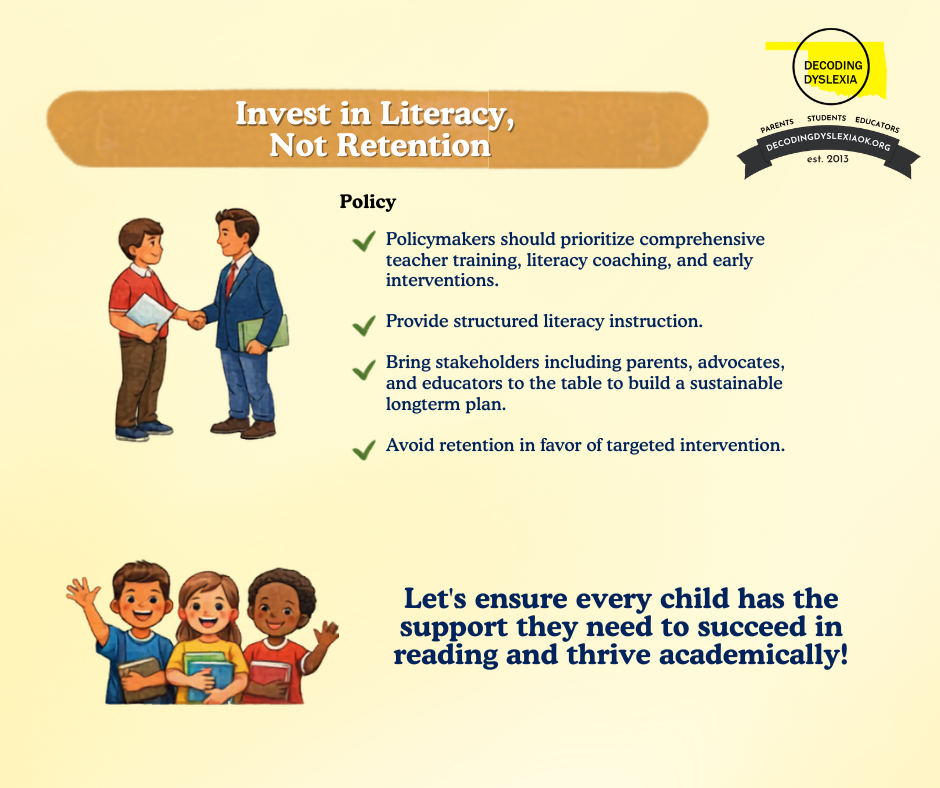
Examining the retention mandate in isolation compared to states with similar literacy initiatives that allow local discretion over retention, the beneficial effects diminish. The state-mandated retention policy only works when it comes with the literacy interventions needed to keep students from being retained in the first place. Policymakers should prioritize providing teachers with comprehensive training, literacy coaching, early diagnostic systems, and long-term literacy interventions to address the root causes of students’ poor reading acquisition. (Does State-Mandated Third Grade Reading Retention Policy Improve Achievement? Edworkingpapers.com)
Grade retention or social promotion.
Retaining students who fail to meet grade level standards has limited empirical support. However, simply promoting students to the next grade level, social promotion, is not an educationally sound alternative. The debate between retention and social promotion must be replaced with efforts to identify and disseminate evidence-based practices that promote academic success for students who struggle behaviorally, whose academic skills are below grade-level standards, or who demonstrate chronic absenteeism. NASP urges educators to consider long-termcosts of retention for students and to use other strategies such as multitiered systems of supports, an individualized plan of study for struggling students, or early educational interventions, as these have greater potential to positively affect both long-term educational achievement and employment success. (National Association of School Psychologist Position Paper on Grade Retention and Social Promotion, nasponline.org)
Retention disproportionately harms vulnerable students.
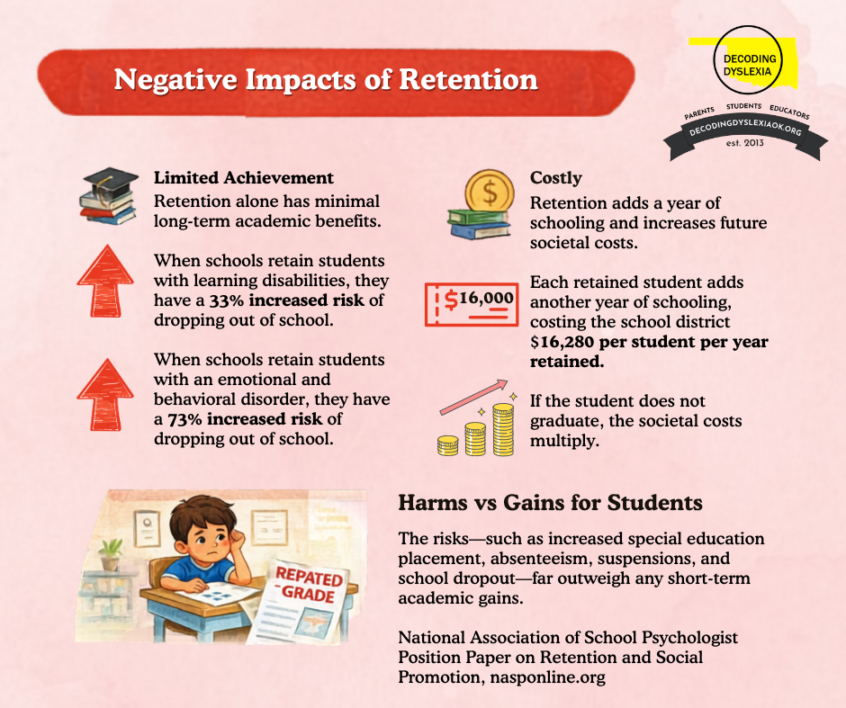
When schools retain students with learning disabilities, they have a 33% increased risk of dropping out of school, and when schools retain students with emotional and behavioral disorders, they have a 73% increased risk of dropping out of school. Students from minoritized backgrounds face even lower graduation rates, deepening social inequities. (National Association of School Psychologist Position Paper on Retention and Social Promotion, nasponline.org)
The negative effects of retention extend into adulthood,
including lower rates of postsecondary education, reduced socioeconomic status, and increased reliance on government assistance. Retention perpetuates cycles of trauma and adverse childhood experiences. Oklahoma already ranks as the third highest in the nation for adverse childhood experiences (ACEs) which include abuse, neglect, household instability, a higher likelihood of poor employment opportunities and the need for public assistance, in addition to increased risk for chronic illness and mental health issues. (Quantifying Adverse Childhood Experiences in Oklahoma with Oklahoma Adversity Surveillance Index System, nlm.nih.gov)
Retention is costly for both the education system and society.
Each retained student adds another year of schooling, costing the school district $16,280 per student per year retained, and if they do not graduate, the societal costs multiply. (National Center for Education Statistics, nces.ed.gov)
Learning to read is not a natural process, it takes skilled instruction.
“We human beings were never born to read: we invented reading and then had to teach it to every new generation. Each new reader comes to reading with a ‘fresh’ brain -one that is programmed to speak, see, and think, but not to read. “ (Wolf, M. 2007, Reading Worrier) “High -quality instruction is the key to ensuring that all children learn to read and write. Moreover, researchers have noted the important and positive impact that a knowledgeable teacher can have on a child’s literacy acquisition, particularly for children who struggle to acquire basic literacy skills.” (Joshi, Washburn, & Kahn- Horwitz, 2016, Introduction to the special issue on teacher knowledge from an international perspective. Annals of Dyslexia)
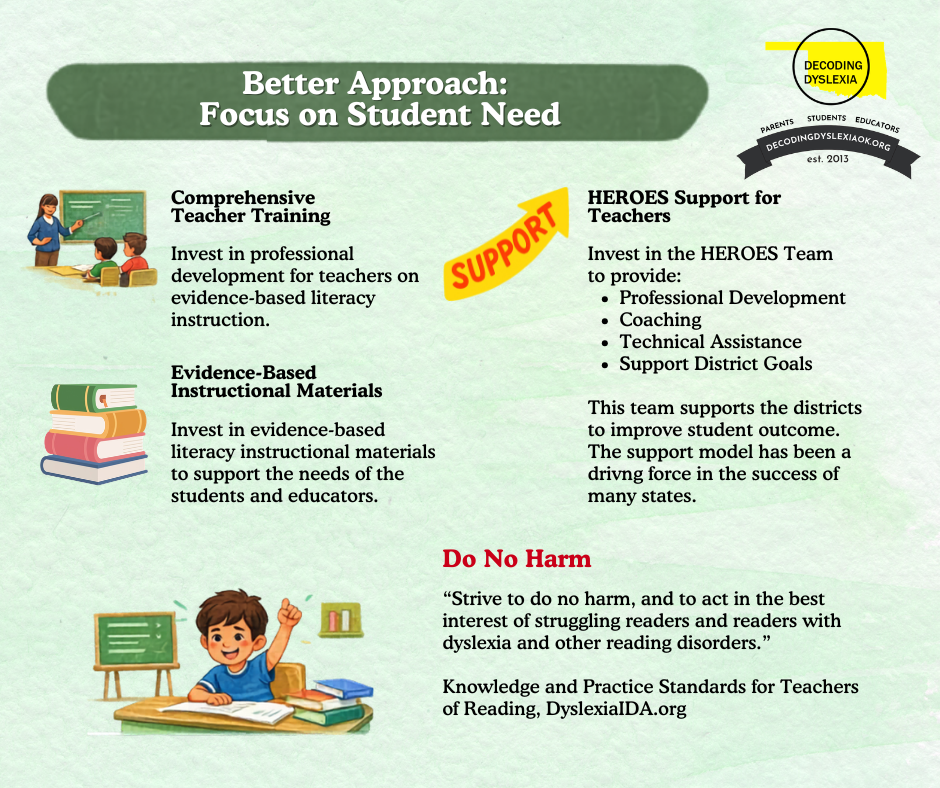
The International Dyslexia Association’s Knowledge and Practice Standards define the essential evidence-based knowledge, skills, and ethical behaviors required for teachers to effectively instruct all students in reading and writing, specifically through structured literacy. All students must receive highly trained educators equipped with the knowledge of reading development and dyslexia, proficient in assessment and interpretation, able to implement structured literacy instruction which includes the explicit, systematic, and cumulative instruction of phonology, sound-symbol association, syllable patterns, morphology, syntax, and semantics, and adhere to ethical standards, including data-driven decision making and professional development. The ethical standard expects teachers to “strive to do no harm, and to act in the best interest of struggling readers and readers with dyslexia and other reading disorders”. Retention harms students with dyslexia and therefore should be avoided. Oklahoma must invest in mandatory teacher preparation to ensure every educator is equipped with knowledge, skill, resources, and ethical standards to effectively teach and support all children to become confident, competent readers. (Knowledge and Practice Standards for Teachers of Reading, dyslexiaida.org)
Retention is neither effective nor ethical for addressing literacy challenges. Retention is a failed intervention strategy that not only punishes children with disabilities and their families, but it also dooms their ability to benefit from education due to their higher risk of dropping out of school.
The better approach is investing in comprehensive statewide teacher training and evidence-based reading instruction for all students. We urge policymakers, educators, and families to reject retention as a literacy strategy. Instead, we demand investment in comprehensive teacher training and early intervention programs. Together, let us ensure every child in Oklahoma receives the skilled instruction and support they need to become confident, competent readers. We look forward to continuing the conversation as we work together to serve struggling readers in Oklahoma.
Sincerely,
Decoding Dyslexia Oklahoma and our partners,
“Strive to do no harm, and act in the best interest of struggling readers and readers with dyslexia and other reading disorders.”
Knowledge and Practice Standards for Teachers of Reading, The International Dyslexia Association